


What You Do in the Practice Room Is the Thing That Fails You On Stage
You are four bars into the excerpt when one note lands slightly under. It is small. Nobody in the room would call it a disaster, and in a week you will not remember which note it was. But something happens in the next second that costs you far more than the note did. Your attention goes back to it. And it stays there. The rest of the excerpt gets played by someone who is not entirely in the room.
Most musicians read that moment as a concentration problem, and go looking for ways to focus harder. It is not a concentration problem. It is the most trained reflex you own, doing exactly what you spent years teaching it to do, in the one place where it cannot help you.
The reflex that made you good
In the practice room the sequence runs in under a second. You hear something, you judge it, you correct it. Hear, judge, fix. That is not a character flaw or a sign of an anxious personality. It is the entire mechanism by which anyone gets better at an instrument. Thousands of repetitions of noticing what is not right and changing it immediately is how a shift becomes reliable, how an entrance stops being a gamble, how a passage you could not play in September is unremarkable by December.
You have rehearsed that loop more than you have rehearsed any excerpt on any list. By now it runs faster than your conscious thought. It is the most professional thing about you.
What happens when you take it on stage
On stage the first two steps still work perfectly. You hear the note. You judge it, instantly and accurately, because your ear was trained by exactly the same repetitions. Then the third step arrives and finds nothing to do. The note is gone. There is no going back to isolate the shift, no slowing it down, no second attempt. The correction has no object.
The impulse does not switch itself off just because the situation changed. It turns inward instead. Rather than correcting the note, it begins correcting you, and it does that while you are still playing. This is a large part of why playing that is completely solid at home changes the moment someone is listening.
What it actually costs
The cost is not abstract. For the next several bars you are playing from a memory rather than from what is in front of you. Your ear, which is your best instrument, is now checking the present against something that already happened, which makes it less reliable rather than more. Your hands respond to the sense that something is going wrong by holding on tighter. The bow arm grips, the vibrato hardens, the sound narrows exactly at the moment you most want it open.
And the loop does not stop when you do. Hours later, at home, it is still running, which is why the mind replays a performance and quietly rewrites it until the version you remember is noticeably worse than the one that actually happened.
The skill nobody trains
The alternative is not lower standards, and it is not the advice to relax and let go, which has never once helped anyone in the middle of an exposed entrance. It is a specific and quite ordinary skill: noticing what is there without doing anything about it. Observing without fixing.
I want to be honest about how that feels the first few times, because most people are not warned. It feels wrong. Sitting with a tight jaw or a shallow breath and deliberately not correcting it can feel like passivity, like giving up on quality, like the least professional thing you have ever done. That discomfort is not a sign the practice is failing. It is the practice. What you are building is the gap between noticing and acting, and at the moment you do not have one.
How to build it
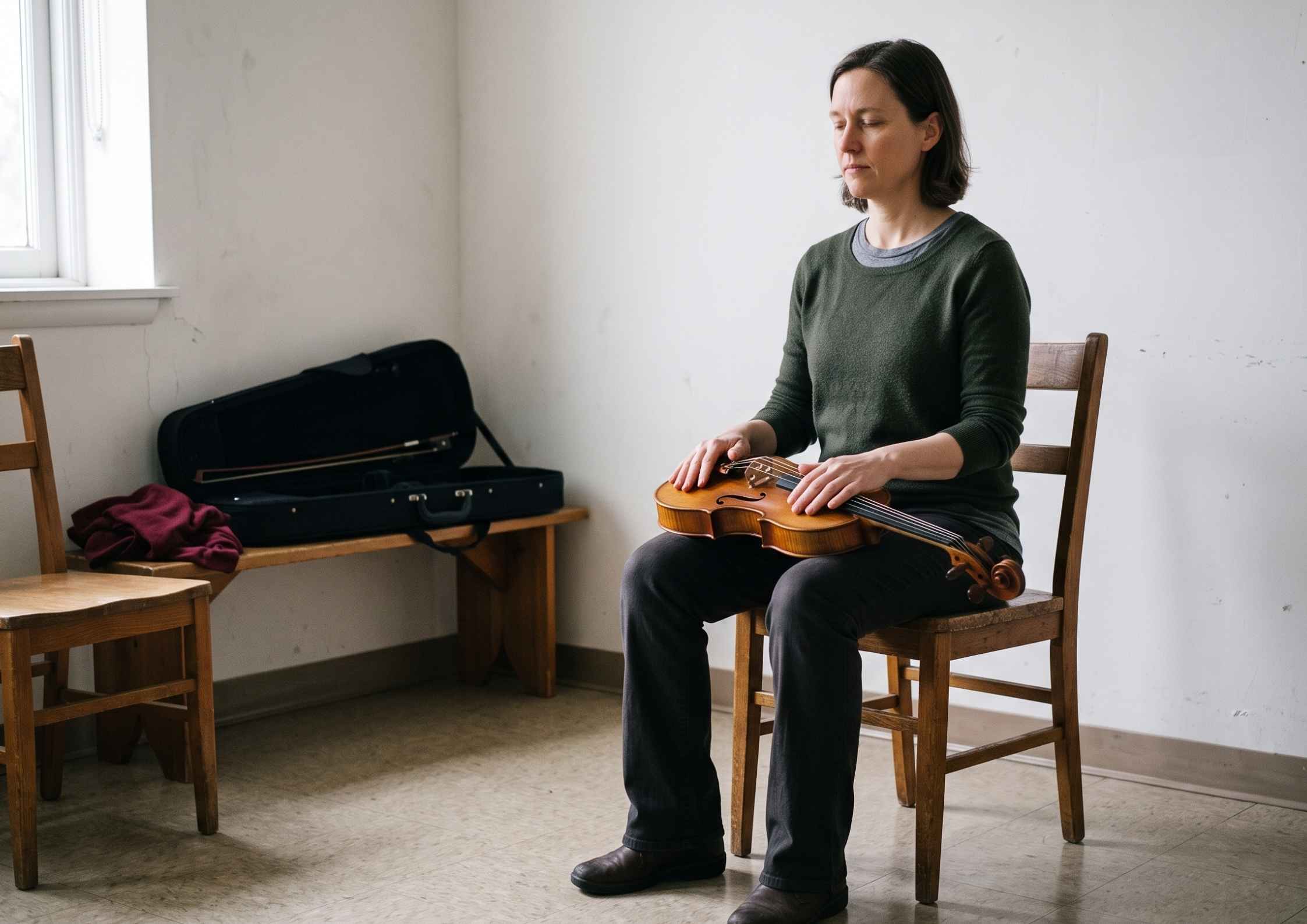
Start away from the instrument, because there is nothing to fix there and the reflex has less to grab. Fifteen minutes a day, sitting upright in the posture you would use to play rather than anything that looks like meditation. Move your attention through the places where pressure tends to arrive first: the feet on the floor, the hands, the jaw and throat, the breath. The only instruction is to change nothing. You are not relaxing anything. You are learning what it is like to observe something uncomfortable and leave it exactly where it is.
Keep it short enough that it survives a busy week, and do it at the same time each day. Consistency does far more here than length, and fifteen honest minutes for three weeks will teach you more than an occasional hour.
Then take it into conditions that resemble the real thing. One take, no restarts, ideally with someone listening, which is what practising under observation is genuinely for. And add one rule to your ordinary practice: when you are running something as a performance, you finish. You do not stop to correct. That single rule trains carrying rather than correcting, and almost nobody does it.
But won't this make me sloppy?
This is the objection every serious musician raises, and it deserves a straight answer. No, because nothing is being removed. The fixing reflex stays. You keep it, you sharpen it, and you use it in the room where correction still means something. What changes is that it now has a boundary.
High standards are not the problem in themselves. The problem is what they do to your attention in the moment of playing, when the judgement is accurate and the correction is impossible and the two of them together take the next eight bars with them.
Two rooms, two jobs
The practice room is where you fix. The stage is where you carry. They ask for opposite things, and most of us have only ever trained one of them, then wondered why the other one keeps collapsing under pressure.
None of this makes you a calmer musician, and it is not meant to. It changes where your attention is standing. The note that went under still went under. It simply stops taking the rest of the excerpt with it, and over time that turns out to be most of what separates a performance you can trust from one you survive.
Frequently Asked Questions
Does this mean I should ignore mistakes while I am performing?
No. You will notice them, and you should. The distinction is between registering something and acting on it. Noticing takes an instant and costs nothing. Attempting to correct or explain something that has already gone past is what removes you from the next phrase.
How long does it take before this makes a difference?
For most musicians something shifts within about three weeks of daily practice, which is roughly how long it takes for any physical skill to start being available without effort. What usually changes first is not the amount of tension but how quickly you notice it, and that alone gives you far more room than you had before.
I only lose this in auditions, not in concerts. Is it the same thing?
Usually yes, with the volume turned up. In a concert the music keeps moving and the section carries you. In an audition you are alone, the material stops and starts, and every gap gives the correcting reflex somewhere to go. The mechanism is the same; the audition just removes everything that used to cover it.
Should I stop recording myself in the practice room?
Recording is useful when you are working on material and reviewing it afterwards with a pencil. It becomes counterproductive when you record a passage over and over and keep only the best take, because that trains a skill nobody will ever ask you for. Record the first take and work from it.

Instagram
Facebook
LinkedIn
Website