


Why You Can Play It at Home but Not Under Pressure
One of the most unsettling experiences for a musician is knowing that you can play something — and then feeling that ability disappear the moment somebody listens.
In the practice room, the passage feels settled. The shift arrives naturally. Your breathing is free enough, and the musical line makes sense. Then you walk into a lesson, rehearsal, audition or concert and something shifts. The same passage feels uncertain. Your hands seem less familiar. You start wondering whether the next note will speak.
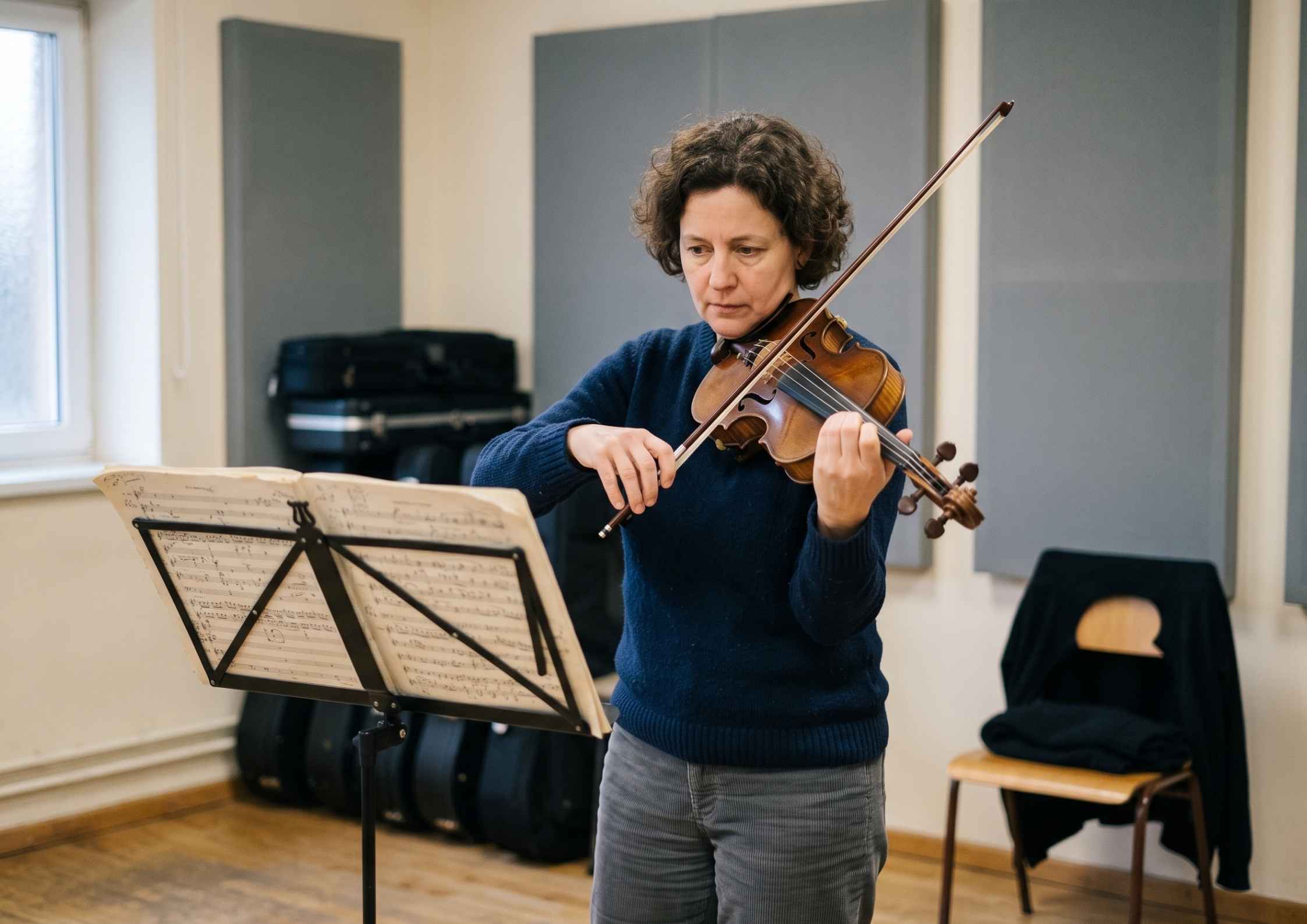
It is tempting to conclude that the preparation was not secure enough. Sometimes more preparation is genuinely needed. But often the larger change is not in your technique. It is in where your attention goes when the situation begins to matter.
The notes are the same, but your attention is not
At home, your attention is usually connected to a task: listening to the sound, shaping a phrase, sensing a movement, following the direction of the music. You are in a familiar room, and there is little immediate consequence if something goes wrong. This gives your trained responses space to operate.
When another person listens, attention can turn inward. Instead of hearing the phrase, you begin listening for evidence that you are good enough. Instead of allowing the shift to happen, you check whether your hand is about to miss it. Part of you is playing while another part is evaluating the person who is playing. This is closely related to what fear of judgment does inside a rehearsal or audition room — the split attention itself becomes the problem, independent of the technical level.
That division is tiring. It also interferes with actions that are normally coordinated without conscious supervision. The more urgently you try to control every detail, the less available you may feel.
Feeling judged changes the meaning of a mistake
A mistake at home is information. You notice that a note was sharp, a response was late, or a bow change disturbed the line. You can become curious about what produced it.
Under pressure, the same mistake can feel like a verdict. The mind moves quickly from “that note was sharp” to “I am losing control.” Once that happens, the next passage is no longer simply music — it becomes an opportunity to prove that the previous mistake did not define you. This is the same mechanism that makes performance nerves feel so difficult to manage: not the sensation itself, but the story the mind builds around it.
This is one reason technically capable musicians can sound less secure in important situations. They are not only performing the piece. They are also trying to manage what the performance might mean.
You may be practising tension without realizing it
We tend to think of practice as the repetition of notes and movements. But every session also rehearses a way of paying attention. If you practise a difficult passage while bracing for the error, checking yourself after every attempt, and refusing to stop until you feel reassured, you are learning more than the passage. You are learning to approach it as a threat.
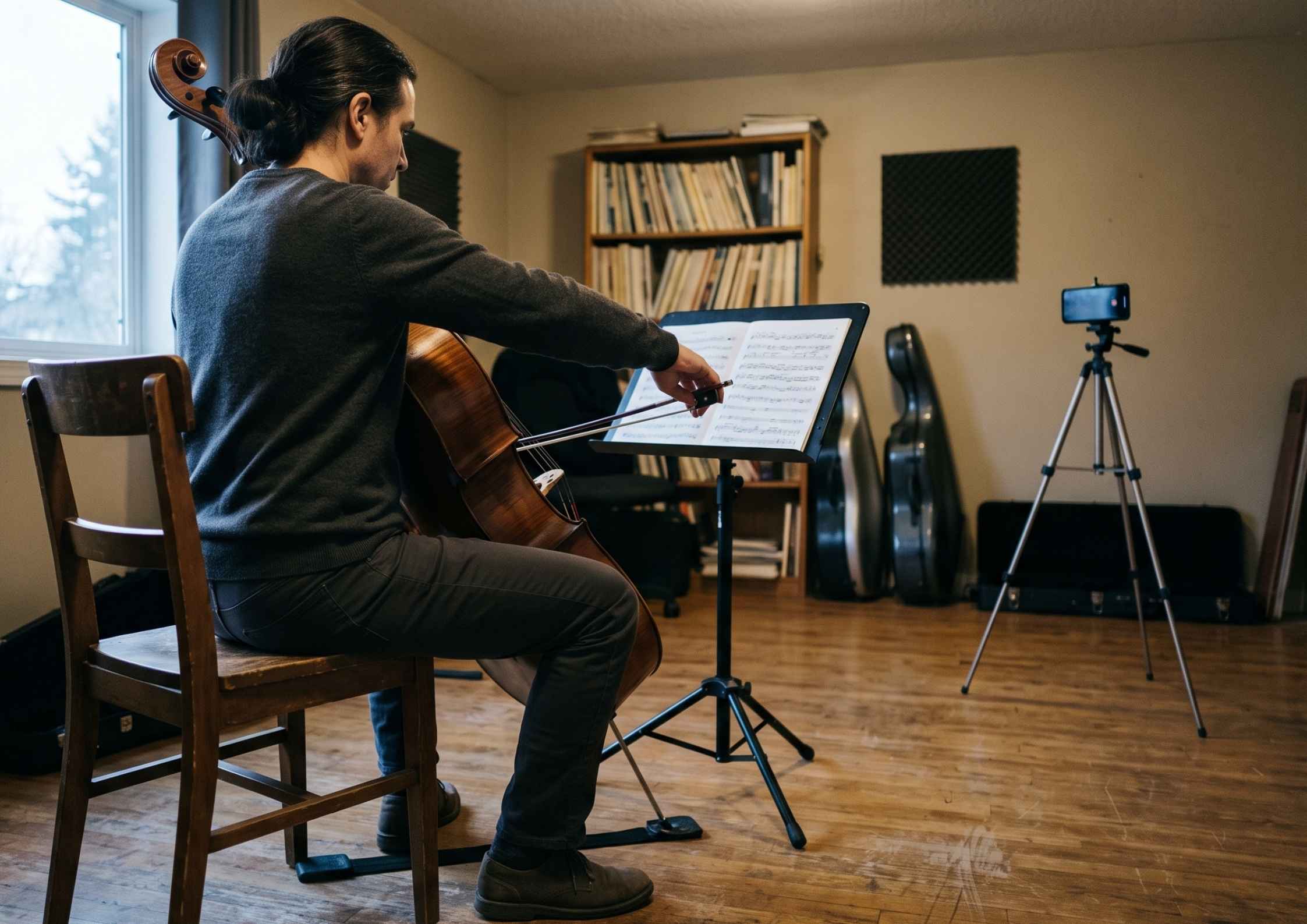
Pressure does not invent an entirely new relationship with the music. It tends to magnify the relationship you have been rehearsing.
How to prepare for being heard
1. Give your attention a musical destination
Before you begin a run, choose one clear place for your attention. It might be the direction of the phrase, the resonance of the room, the pulse underneath a difficult entrance, or the sound you want to send beyond the music stand. A useful focus is specific enough to return to when self-evaluation appears.
2. Practise in the presence of consequence
A recording, a trusted colleague or a simple mock performance can change the emotional temperature of the room. Use these situations to observe where your attention goes — not merely to judge the result. Start with manageable exposure, then increase it gradually. The aim is to become familiar with being heard while staying connected to a musical task.
3. Include recovery in your definition of success
A reliable performance is not one in which nothing unexpected happens. It is one in which an unexpected event does not take the rest of the performance with it. During run-throughs, resist the urge to stop after every slip. Practise continuing, rejoining the phrase and restoring your attention. Recovery is a skill, and it deserves rehearsal.
4. Separate observation from judgment
After a run, begin with what you noticed rather than what you think it says about you. Where did the breath become shallow? When did the pulse feel clear? Which moments drew you into the music? This kind of observation gives you something workable. The mind’s tendency to reinterpret what happened under pressure is one of the reasons this step matters so much: the story you build immediately after a run is rarely as accurate as the one you build an hour later.
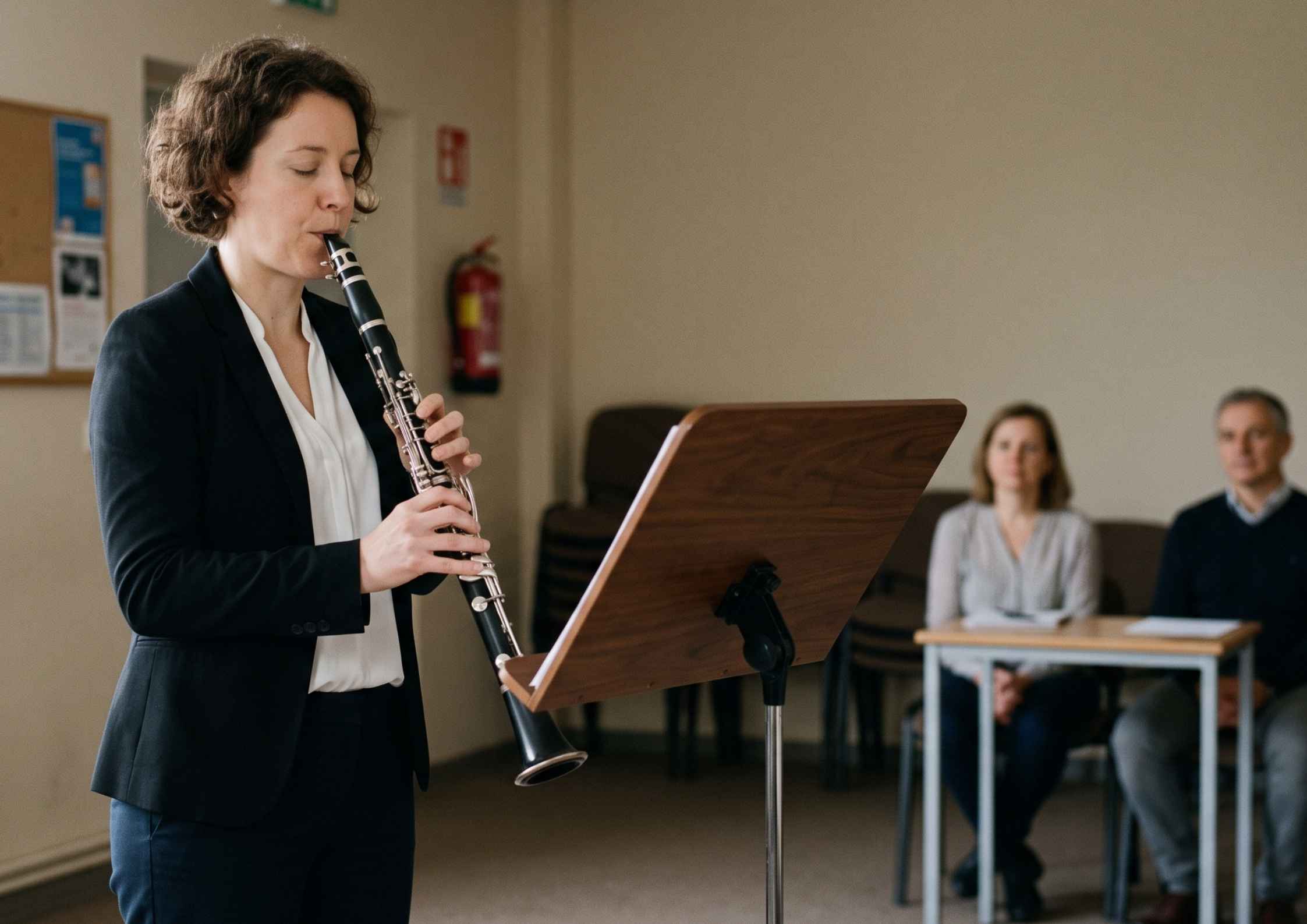
Your ability has not disappeared
You already know what it feels like to become absorbed in sound, movement and communication. Preparation under pressure is the process of making that connection available in less comfortable rooms — not by forcing yourself to feel fearless, but by repeatedly returning to what you are there to do.
FAQ Section — Article 1
Why do I play better when nobody is listening?
Privacy reduces self-monitoring and fear of judgment, allowing well-trained movements to happen more automatically. When someone listens, attention may shift from the music to how you are being perceived.
Do mock auditions make performance anxiety worse?
They can feel uncomfortable at first, but well-designed mock auditions create a gradual and useful form of exposure. Keep the challenge manageable and evaluate how you directed your attention, recovered and communicated — not only how many mistakes occurred.
Should I practise more if I become unreliable under pressure?
Not automatically. First identify whether there is a technical gap or an attention problem. More repetition can help a genuine technical need, but it may reinforce anxiety when it is used mainly to seek reassurance.

Instagram
Facebook
LinkedIn
Website