


A Bad Rehearsal Does Not Define You as a Musician
You leave the room and it comes with you.
The rehearsal is finished. The stand is folded, the case is closed, the space you were in no longer exists in any practical sense. And still, something in you has not quite left. A passage keeps replaying — not clearly, not usefully, but with that particular sticky quality of something that did not resolve. The session felt off in a way that is hard to locate precisely, which somehow makes it harder to put down.
And at some point, without deciding to, you stop replaying the music. You start replaying yourself.
This is where a bad rehearsal becomes something heavier than a bad rehearsal. Not in the room — in the minutes and hours after it, when the mind starts asking what it means. And the answer it reaches for is rarely “that was a difficult afternoon.” It is usually something closer to a question you hoped you had already settled: am I still okay?
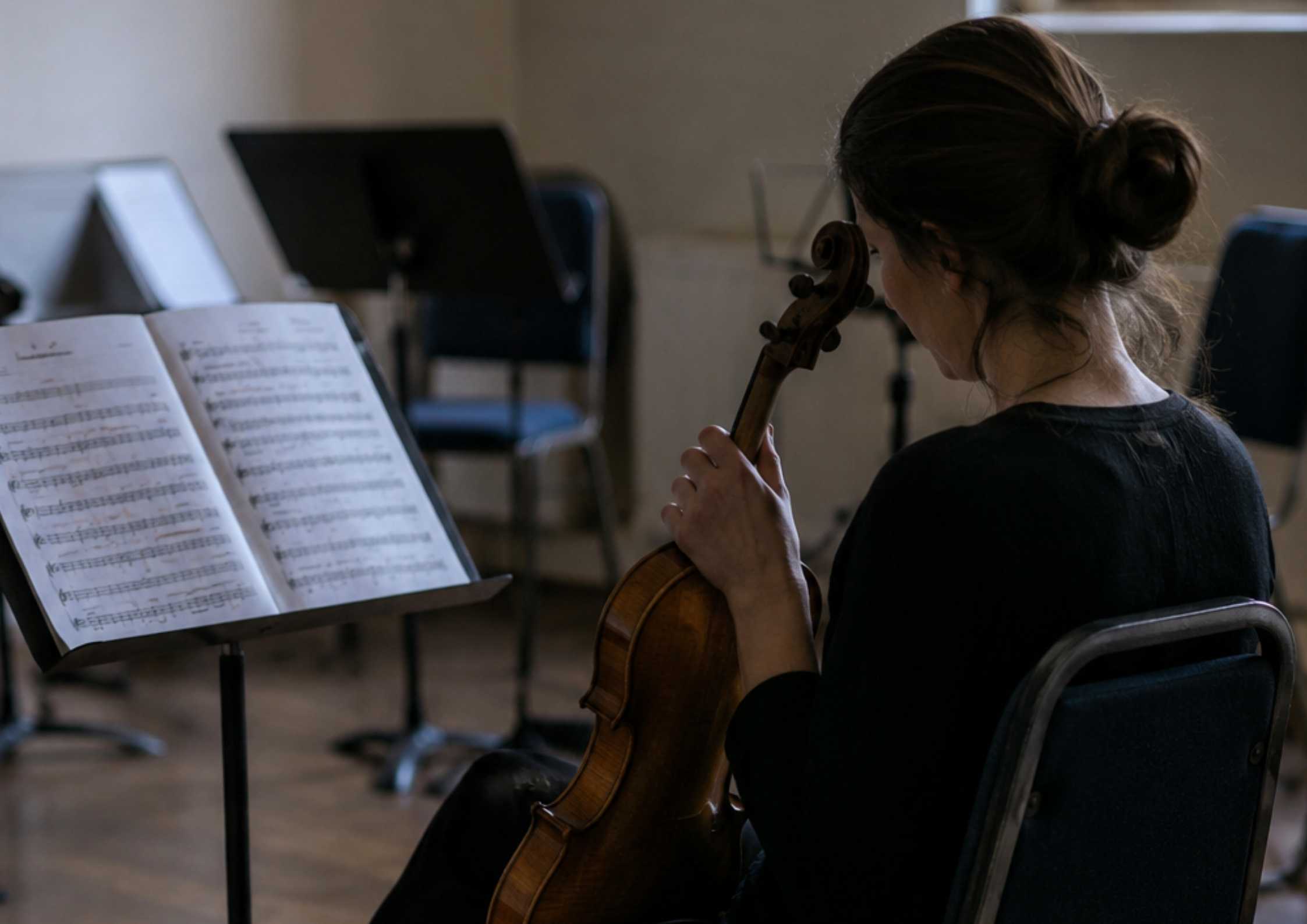
That question changes everything. And it is worth understanding why it arrives so quickly, and what it is actually asking.
Why one rough rehearsal feels so personal
Musicians are trained to listen closely. You notice detail — what is slightly late, uneven, unfocused, emotionally unconvincing. You learn to care about things most people would never register. That sensitivity is part of the work.
But the same sensitivity becomes painful when it turns inward without perspective.
After a difficult rehearsal, the mind does not simply note that a passage needs work. It can begin to conclude that you are not good enough. Not that you were tired or underprepared for a specific section — but that you may not belong in the room at all.
This happens because music is not separate from the person playing it. Your sound comes through your body, your nervous system, your history, your confidence, your fatigue. When something goes badly, it can feel as if something in you has been exposed.
But being exposed in a difficult moment is not the same as being defined by it.
A rehearsal is a snapshot. Not a biography. It shows something about that day, that room, that repertoire, that particular intersection of preparation and pressure. It may show something important. It may ask for your honest attention. But it does not contain the whole truth of who you are as a musician.
The mind moves faster than the truth
After a bad rehearsal, most musicians do not pause long enough to understand what happened.
The move into judgment is almost immediate. The session felt unstable, so the conclusion becomes: I am unstable. Concentration was off, so the conclusion becomes: something is wrong with my level. A few things missed their place, and suddenly the trust built over months feels like it may have been an illusion.
None of this is rational. But none of it is weakness either. It is what happens when music carries so much of your identity, and one session disturbs the surface.
The mind wants a story quickly. It wants to know what this means before the feeling becomes harder to hold. And when the stakes feel personal, the stories it reaches for are rarely generous ones.
This is also why a bad rehearsal can begin affecting the next session before the next session has even happened. You arrive not only to work, but with a memory, a residue, a question you are still trying to answer. The inner posture — tight, searching, slightly braced — changes how you listen, how you assess, and how much danger you attach to small things that would otherwise barely register.
A bad rehearsal is information
One of the most useful shifts is also one of the simplest: treat the rehearsal as information before treating it as judgment.
This does not mean pretending it went well. Musicians need honesty. If something was weak, unclear, or unstable, it is useful to know that. But honesty is different from self-attack.
A difficult session might be telling you that your preparation was too narrow — that you practised the part in isolation but not enough in relation to the full texture. It might reveal that a tempo felt manageable at home but not under ensemble pressure. It might show you that your recovery after mistakes needs more attention than the passage itself.
Sometimes the information is physical: you were overloaded, your concentration thinner than usual, your body not settled enough to respond freely. Sometimes it is something more internal: you were listening through fear, trying to avoid mistakes rather than make music.
None of this means you are failing. It means the rehearsal gave you material. And material can be worked with.
The problem with reviewing too soon
Many musicians try to analyse a difficult rehearsal immediately, while the body is still full of adrenaline, shame, or frustration. That is usually not analysis. It is emotional sorting under pressure.
Right after a difficult session, the mind often becomes extreme. It looks for a quick explanation because uncertainty feels unbearable. It may decide the problem was your talent, your future, your discipline, or your right to be there.
I recognise this pattern in myself. There have been rehearsals I left feeling genuinely shaken — and then returned to the next day to find that most of what felt catastrophic was ordinary difficulty seen through an exhausted and slightly frightened mind. The music had not changed. My state had.
What helped was not pretending the session was better than it was. It was simply waiting. Creating enough distance between the experience and the interpretation. Not everything needs to be decided on the same evening it happened. Sometimes the most intelligent thing you can do after a rough rehearsal is to decide nothing at all, and let the morning offer a more accurate reading.
How to review a bad rehearsal productively
When enough time has passed and the emotional charge has settled, a different kind of review becomes possible.
Start with three questions, kept very small:
What actually happened?
What might have contributed to it?
What is the next useful action?
For example: “I rushed the transition into the faster section” is far more useful than “I always panic under pressure.” “My sound tightened when I felt exposed” gives you something to explore. “I need to practise recovering after a missed entrance” is practical.
The goal is not to make yourself feel better artificially. The goal is to separate the musical information from the identity wound. A difficult rehearsal may show you where your preparation needs more depth, where your confidence still depends too much on everything going well, or where you need to practise staying present after something goes wrong.
That is valuable information. Not comfortable, perhaps. But workable.

You are allowed to be in process
One of the quiet pressures musicians carry is the belief that by a certain stage, certain problems should no longer appear. You should no longer lose focus. You should no longer have rehearsals where your playing falls below your own standard. You should have moved beyond this by now.
A musical life does not work that way.
There will be rehearsals where your sound feels free and connected, and others where everything feels slightly late inside you. There will be moments when an old fear reappears, even after you thought you had outgrown it. This does not cancel your growth. Progress is not proved by never having bad rehearsals. It is shown in how you relate to them.
Can you recover more quickly? Can you take responsibility without humiliating yourself? Can you return to the instrument with clarity rather than punishment? These are not small things. They are part of becoming a more stable musician.
Leave the session where it happened
A difficult rehearsal may show you where the preparation needs more support, where the inner structure is less stable than you hoped, where something needs care rather than more pressure. Those are real things. They deserve honest attention.
What it cannot do is tell you who you are as a musician.
Your musicianship is larger than one hour in a practice room with an instrument that was not cooperating and a mind that was carrying too much. It is built from everything that came before that hour, and from everything you choose to do with what comes after it.
Leave the session where it happened.
And come back tomorrow with a quieter question.
FAQ Section
Why do I feel so bad after one bad rehearsal?
Because rehearsals often touch more than technical accuracy. They can bring up fear of judgment, belonging, reliability, and identity. The emotional reaction may be larger than the musical problem because it feels as if something about you has been exposed rather than simply something in your playing.
How should I recover from a bad rehearsal?
Give yourself time before analysing it. Once the emotional intensity settles, identify what actually happened, what may have contributed to it, and one practical next step. Keep the review specific and avoid turning the session into a verdict on your ability.
Does a bad rehearsal mean I was underprepared?
Sometimes, but not always. A rough session can reflect preparation gaps, but it can also reflect fatigue, pressure, unclear listening, unfamiliar ensemble conditions, or difficulty recovering after mistakes. The useful question is not “Am I good enough?” but “What needs attention now?”
How can I stop overthinking what others thought of my playing?
Bring your attention back to what you can verify. You usually do not know what others thought, and trying to resolve that uncertainty keeps you stuck. Focus on the musical information you can use: the passage, the pattern, the reaction, and the next step.
How do I stop a bad rehearsal from affecting the next one?
By not asking the next session to answer the questions the previous one left open. Each session deserves to begin from its own ground, not from the residue of the one before. That starts with noticing when you have brought a verdict into the room with you — and choosing to set it down before you begin.

Instagram
Facebook
LinkedIn
Website