

When Music Becomes the Thing You’re Judged On
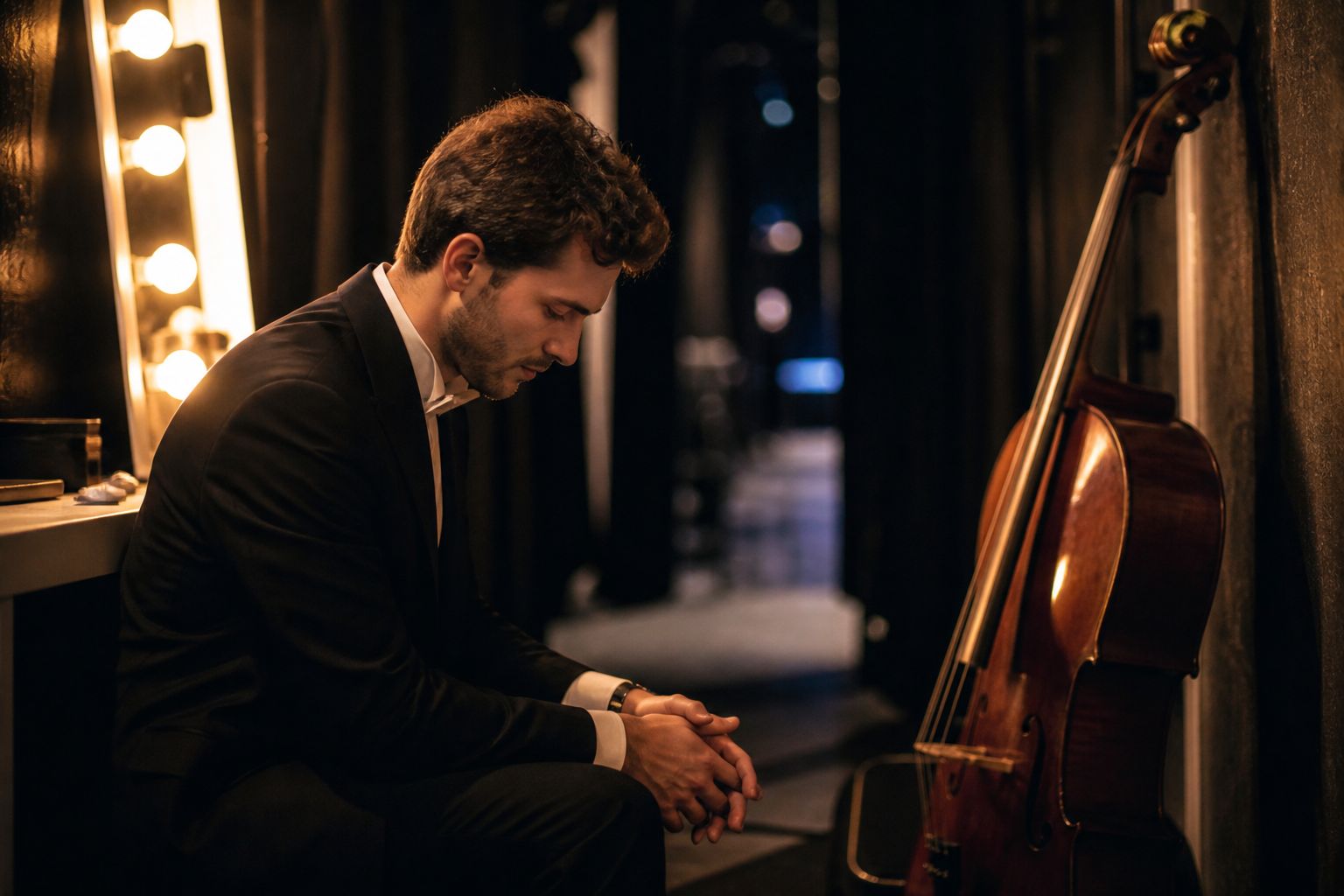
There is a strange pain that many musicians carry quietly.
The thing that once made you feel alive can become the thing that exposes you. The instrument that gave you a voice can start to feel like a test. The music that used to invite you in can become a place where every note seems to ask, Am I good enough?
This is one of the hardest parts of music performance anxiety. It is not only that you feel nervous before a concert, audition, exam, or important rehearsal. It is that your relationship with music itself begins to change under pressure.
Music stops feeling like something you enter.
It starts feeling like something you have to survive.
The Quiet Shift From Expression to Evaluation
Most musicians do not notice this change at first.
You prepare. You practise. You listen. You correct. You try again. You care deeply, so you work more. And because the standard is high, you learn to hear every small imperfection.
At a certain point, this careful listening can become something harsher. The phrase is no longer just a phrase. It becomes evidence. The sound is no longer just sound. It becomes a verdict. A small mistake no longer feels like information. It feels like a warning about who you are.
This is where music performance anxiety becomes more than nerves.
It becomes a lens.
Through that lens, everything is interpreted as judgment. The panel is judging. The teacher is judging. The colleagues are judging. The audience is judging. And perhaps most painfully, you are judging yourself before anyone else has the chance.
You may still love music. But inside the pressure, love can get buried under proving.
Why “Just Enjoy the Music” Often Does Not Help
When musicians are anxious, they are often told to enjoy the music.
The advice is usually well meant. It is also often too simple.
If music has become the place where you feel evaluated, telling yourself to enjoy it can create even more pressure. Now you are not only trying to play well. You are also trying to feel free, inspired, connected, expressive, calm, and grateful.
That is a lot to ask from a nervous system that already feels watched.
Enjoyment cannot be forced. Trust cannot be demanded. Presence cannot be commanded by repeating the right sentence in your head. These things return more gently, through practice, attention, and a different way of relating to the moment.
The goal is not to pretend that the pressure is not there.
The goal is to stop letting pressure decide what music means.
When Music Feels Like a Threat
Under pressure, the brain often tries to protect you.
It scans for danger. It looks for signs that something might go wrong. It remembers past mistakes. It compares you with others. It imagines consequences. It tries to predict rejection before it happens, as if prediction could soften the blow.
In daily life, this mechanism can be useful. In performance, it can become exhausting.
Because the danger is not a tiger in the room. It is a note. A silence. A high entrance. A shift. A soft attack. A panel behind a screen. A colleague listening nearby. The body reacts as if your safety depends on the outcome.
And in a way, emotionally, it may feel that it does.
For many musicians, performance is tied to identity. You have spent years shaping yourself around this craft. You have sacrificed time, comfort, money, relationships, and certainty. When you walk into an audition or step onto a stage, it can feel as if your whole history is standing there with you.
So when someone says, “It’s just music,” something in you may resist.
Because it is not just music.
It is your work, your hope, your discipline, your longing, your sense of belonging, and sometimes your sense of worth.
No wonder it can feel heavy.
The Practice Room Can Train Judgment Too
Many musicians think performance anxiety begins on stage.
Often, it begins much earlier.
It begins in the way you practise. Not because you are doing something wrong, but because the practice room can quietly become a court. You play, judge, correct, repeat. You play again, judge again, correct again. Over time, the body learns that playing means being inspected.
Of course, correction is necessary. You cannot grow without listening honestly. But there is a difference between listening and attacking. There is a difference between refining a phrase and using every imperfection as proof that you are not ready.
If every practice session is built around suspicion, the audition will not suddenly feel like freedom.
This is why the way you practise emotionally matters as much as what you practise technically.
Your nervous system is learning the atmosphere of your preparation.
Returning to Music Through Attention
When music has become the thing you are judged on, the way back is not to convince yourself that judgment does not exist.
It does exist. Auditions involve selection. Concerts involve listeners. Exams involve assessment. Colleagues have opinions. Panels make decisions. Pretending otherwise can feel false.
The deeper shift is to place your attention somewhere more useful.
Instead of asking, “What will they think of me?” you can begin to ask, “Where is the phrase going?”
Instead of asking, “Do I sound good enough?” you can ask, “What kind of sound does this moment need?”
Instead of asking, “What if I fail?” you can ask, “Can I stay with the next note?”
These are not magic questions. They do not remove pressure. But they begin to move you from self-monitoring back into musical contact.
Music becomes less of a mirror and more of a path.
Something you move through.
Music as a Place to Navigate
One helpful reframe is to think of music not as a result you have to present, but as a landscape you navigate.
There is rhythm under your feet. There is harmony around you. There is direction in the phrase. There are colors, tensions, releases, turns, arrivals. There are places where you lead and places where you listen. There are moments that need courage and others that need simplicity.
When you navigate, you are active. You are not standing outside yourself waiting to be approved. You are inside the music, responding to what is happening.
This matters because anxiety often pulls you out of the music and into an imagined audience. You start performing for the opinion in your head rather than playing the phrase in front of you.
Navigation brings you back.
Not perfectly. Not permanently. But again and again.
A Simple Practice for Reconnecting
Choose one excerpt, passage, or piece that often makes you feel judged.
Before playing, take a moment to name what the music asks from you. Not what the panel might want. Not what your teacher would criticize. Not what would prove you are good.
Just the music.
Maybe it asks for direction. Maybe warmth. Maybe pulse. Maybe stillness. Maybe a certain kind of courage in the first sound.
Then play once with only that in mind.
Afterward, do not begin with what was wrong. Begin by asking, “Did I stay in contact with what the music asked for?”
This does not replace technical work. It changes the order of attention. You are still allowed to fix things. But you are no longer using correction to disconnect from the music.
Over time, this builds a different inner habit.
You learn that playing is not only an occasion for judgment. It is also an occasion for relationship.
You Are Not Only Being Heard. You Are Also Listening.
One of the most painful illusions under pressure is the feeling that everyone else is active and you are passive.
They listen. They judge. They decide. You wait to be accepted or rejected.
But performing is not passive.
You are also listening. You are also choosing. You are also shaping time. You are also offering a point of view. Even in an audition, even behind a screen, even when the result is uncertain, you are not only an object being evaluated.
You are a musician.
This may sound obvious, but anxiety makes musicians forget it.
The work is not to become fearless. The work is to remember your role while fear is present.
Coming Back to What Was Yours First
Before music became loaded with auditions, rankings, jobs, comments, comparisons, and consequences, there was probably something simpler.
A sound that moved you. A piece you could not stop listening to. A moment in an orchestra when you felt part of something larger than yourself. A teacher, rehearsal, concert, or phrase that made you think, Yes. This is it.
That part of you has not disappeared.
It may be covered by pressure. It may be tired. It may not trust easily anymore. But it is still there.
And you do not return to it by forcing yourself to be inspired. You return by creating small moments where music is allowed to be music again.
A scale with direction.
A phrase without self-attack.
A rehearsal where you listen more than you defend.
A performance where you come back to the next note instead of punishing the last one.
Little by little, music can become less like a courtroom and more like a place you know how to enter.
Not because nobody is judging.
But because judgment is no longer the only thing in the room.
FAQ
Why does music performance anxiety feel so personal?
Because music is often tied to identity, belonging, and years of effort. When a performance matters, it can feel as if your whole value is being evaluated, even when the actual situation is much smaller than that.
How can I stop feeling judged when I perform?
You may not be able to stop the feeling immediately. A more realistic first step is to redirect attention toward something concrete: sound, breath, pulse, phrasing, or the next musical action.
Is it bad to care what people think of my playing?
No. Caring is human, and musicians need sensitivity. The problem begins when imagined judgment takes over so strongly that you lose contact with the music itself.
Can I rebuild confidence after years of performance anxiety?
Yes, but confidence usually returns through repeated experiences of safety, preparation, presence, and recovery. It is less about one breakthrough and more about rebuilding trust over time.

Instagram
Facebook
LinkedIn
Website