


Why Musical Growth Feels So Lonely Sometimes
Nobody in music talks about the loneliness.
Not really. Not the kind that matters.
There are speeches about community, about the privilege of making music together, about the collective experience of the orchestra or the ensemble or the conservatoire. And many of those things are true. The community is real. The shared language is real. The hours spent together in rehearsal rooms, on tours, in dressing rooms before concerts — those are real.
And still. Underneath all of it, there can be a private loneliness that nobody names, because naming it feels like admitting something you were not supposed to feel.

Your calendar is full. Your colleagues are nearby. Your ears are full of other people's playing. And inside, you are carrying something you cannot quite explain to anyone, including yourself.
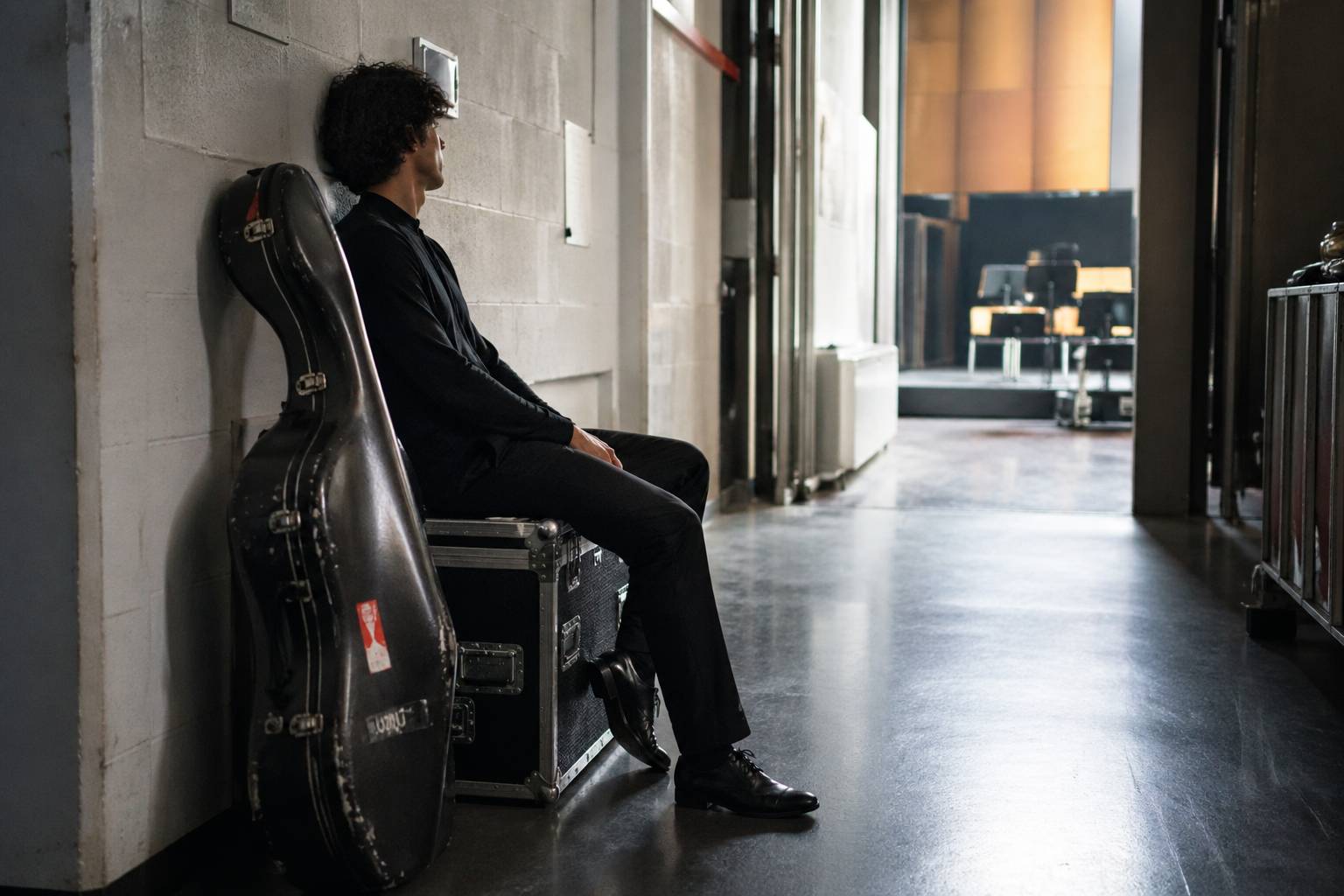
This is what musical loneliness actually looks like. Not an empty room. A full one, where you still feel alone.
Why you can feel alone around other musicians
One of the most confusing things about musical loneliness is that it tends to appear precisely inside community.
You sit in rehearsal surrounded by people who know the repertoire, the language, the lifestyle, the pressure. On paper, these should be the people who understand you best. Sometimes they do. But musicians also learn very early to hide what is actually happening.
You learn to arrive prepared even when you are not. You learn to manage your face after a mistake. You learn to make uncertainty look like focus. You learn to answer “How are you?” with something light enough to keep the conversation moving.
In competitive environments, honesty can feel like a liability. And the professional music world is, structurally, a competitive environment — which is part of what the emotional cost of belonging in classical music actually looks like in practice: you adapt so constantly to what the environment seems to require that the distance between who you are and what you show can become very large.
The loneliness grows in that gap. Not because you are isolated. Because you are performing connection rather than experiencing it.
Pressure makes comparison louder
Musicians compare themselves when they feel uncertain. This is not a character flaw. It is what happens when you are inside a system that ranks, evaluates, and sorts people constantly.
You compare how quickly someone else learns. How calm they seem before auditions. How clean their excerpts sound through the practice room wall. How easily they seem to carry what you find heavy.
Comparison rarely tells the whole truth. It gives you a narrow window into someone else's external life and asks you to measure your entire inner experience against it. And during periods of growth — when your technique is changing, your preparation habits are shifting, your relationship with pressure is being rebuilt — you can feel less fluent before you become more free. The inside of growth feels messier than the outside of anyone else's path.
This connects directly to a pattern that makes the loneliness worse: depending on external response to know whether you are okay. When approval becomes the primary way you orient yourself, the absence of clear positive signals — which is most of the time, in most musical environments — can feel like evidence that something is wrong. It is not. It is just silence.
The hidden isolation of high standards
There is a particular kind of loneliness that comes with high standards. Not because standards are wrong — they are not. But because they can become a way of keeping yourself separate from other people.

If you only allow yourself to be seen when you are doing well, you will spend most of your time hidden. If every difficult session becomes private evidence of inadequacy, you will carry that privately. If you have learned to equate vulnerability with weakness, you will show the polished version and live inside the unpolished one.
This is one of the less-discussed consequences of perfectionism in musicians: when standards stop serving the music and start serving self-protection, they also stop allowing genuine contact. You become harder to reach — not because you are cold, but because being reached feels too exposed.
Many musicians become isolated not because they cannot connect, but because they have built a version of professionalism that leaves no room for being unfinished. And growth, by definition, requires being unfinished.
Growth often separates you from old certainty
There is a particular loneliness that arrives when you can no longer rely on the identity that used to hold you together.
Maybe you were the disciplined one. The one who could always push through. The one who never needed help. The one whose preparation was never in question.
At some point, musical growth may ask you to become more honest than that. You may realise that more hours are not solving the deeper issue. You may notice that the confidence you built through control is fragile in a particular way — it holds until the conditions change, and then it does not hold at all. You may begin to see that the version of yourself that helped you survive the early years cannot carry you into the next stage.
That space between identities is genuinely uncomfortable. You are no longer who you were, and you are not yet fully who you are becoming. From the outside, nothing may look different. From the inside, the ground has shifted.
Most musicians go through this alone. Not because they have to. Because they do not know it is allowed to be spoken.

The problem with collective silence
Musical culture has a particular relationship with difficulty: it tends to aestheticize it.
Struggle gets reframed as dedication. Exhaustion gets reframed as passion. Isolation gets reframed as focus. The musician who suffers most visibly is sometimes the one most admired for how seriously they take the work.
This is not only unhelpful. It is actively isolating. Because it means the musicians who are struggling quietly have no language to bring their experience into the open, and the musicians who are not struggling have no model for how to acknowledge difficulty without it becoming a confession of weakness.
The loneliness that results is not accidental. It is produced by a culture that has learned to treat the inner life of a musician as irrelevant, or as something to be overcome, rather than something to be understood.
And so musicians carry things that could be shared. Not because nobody else feels them — they do — but because nobody speaks first.
What actually helps
Not all support reaches the right place.
Some support tries to fix you too quickly. Some reassures you in a way that feels kind but does not reach the actual difficulty. Some advice is offered before the shape of the problem is understood.
What tends to help is something different. Not consolation, but contact — the experience of being understood by someone who knows how specific this world can be. A teacher, colleague, coach, or mentor who can hold your seriousness without making your struggle the whole story. Someone who helps you separate your playing from your worth without pretending that separation is easy.
And perhaps most practically: a structure that allows you to keep working without constantly abandoning yourself in the process. Growth does not require more pressure. Very often it requires more honesty — about what is actually hard, about what you actually need, about how the work is actually going rather than how it is supposed to look.
You do not need everyone to understand. You need a small number of places where you can be truthful. That is often enough to change everything.
Loneliness is not a sign that you are failing
If your musical growth has started to feel lonely, that is not evidence that something has gone wrong.
It may mean you are changing in ways that are not yet visible to anyone, including yourself. It may mean you are becoming more honest about what this life actually costs. It may mean you have outgrown a version of yourself that is no longer serving you, and the new version has not fully arrived yet.
That in-between place is where most of the real work happens. And almost nobody talks about it, which is exactly why it feels so private, so strange, and so much like a personal failing rather than a completely normal part of a serious musical life.
You are not the only one who has felt this way in that practice room, or that rehearsal hall, or that dressing room before walking on stage.
You are just one of the ones willing to look at it honestly.
That is already something.
FAQ Section
Why do musicians feel lonely even when surrounded by people?
Because the public side of music often hides the private emotional experience. You can be around people all day while still feeling unable to speak honestly about pressure, doubt, comparison, or uncertainty — especially in environments where vulnerability reads as weakness.
Is loneliness as a musician normal?
Yes, and more common than most musicians admit. It tends to appear during periods of growth, transition, auditions, burnout, or professional uncertainty. It is not a sign of failure. Very often, it is a sign that the inner life is asking for something the external environment is not providing.
How does comparison make musical loneliness worse?
Comparison gives you a partial view of someone else's outer life and asks you to measure your whole inner experience against it. During growth, your inside always looks messier than someone else's outside. The comparison is structurally unfair — and yet almost impossible not to make.
What kind of support helps musicians most?
Support that is specific rather than generic, and that makes contact with the actual difficulty rather than smoothing over it. The most useful support helps you understand your own patterns, return to practical work, and separate your worth from your playing — without pretending any of that is simple.

Instagram
Facebook
LinkedIn
Website